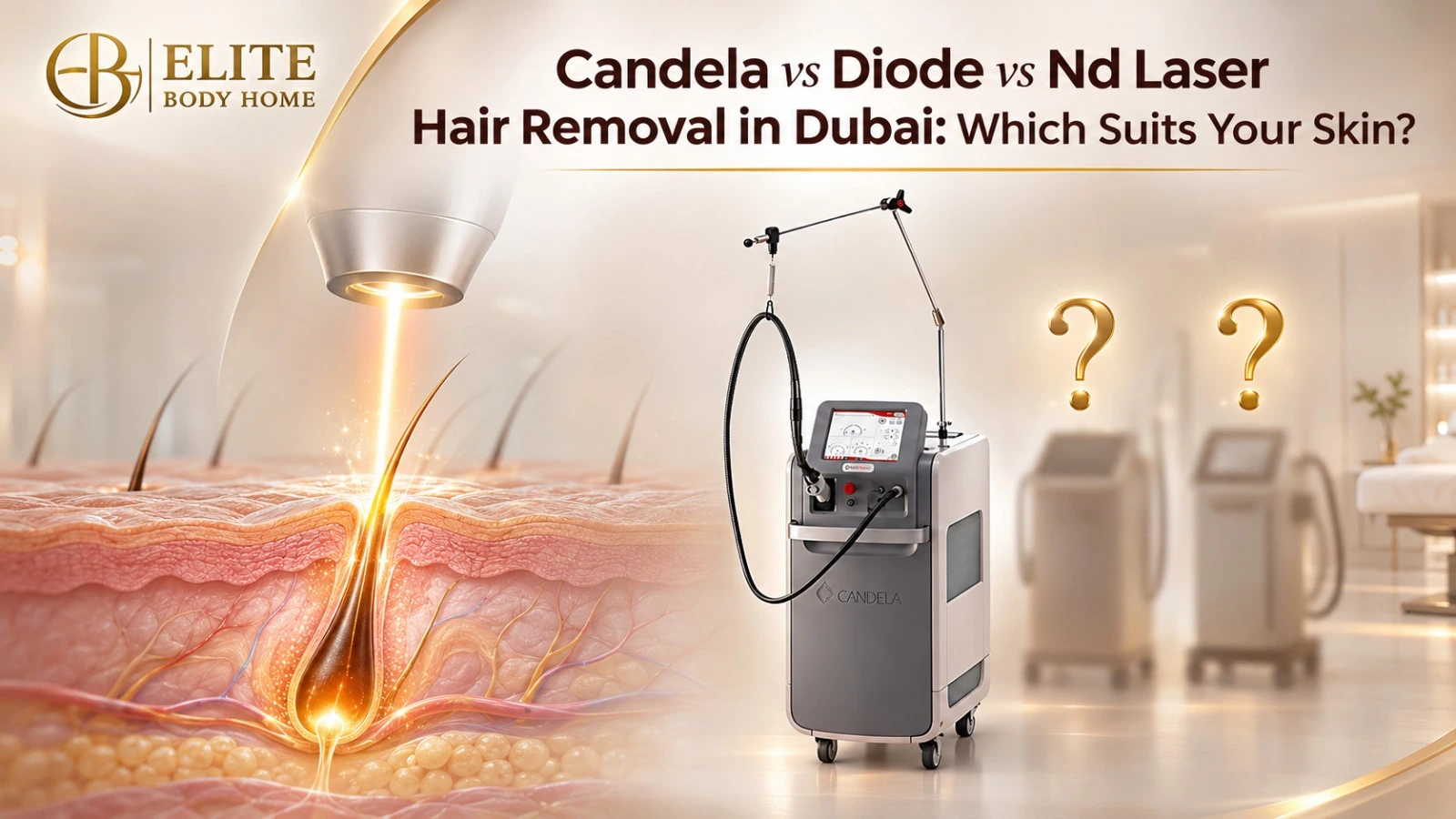
Candela Alexandrite vs Diode vs Nd Laser Hair Removal in Dubai: Which Suits Your Skin?
Written by: Elite Body Home Polyclinic Content Team
Proposed Medical Reviewer: Dr. Arsany Ayoub – DHA-Licensed Aesthetic Doctor
Choosing laser hair removal in Dubai involves more than comparing treatment prices or device brands. Your skin tone, hair colour, hair thickness, recent sun exposure and medical history all influence which laser technology may be appropriate.
Three commonly discussed hair removal technologies are Alexandrite, Diode and Nd.
Candela is a medical aesthetic device manufacturer rather than a separate laser wavelength. Certain Candela platforms, including dual-wavelength GentleMax systems, combine 755 nm Alexandrite and 1064 nm Nd technology.
This means patients comparing Candela with diode or Nd should first understand which wavelength is being used.
In this guide, we explain how Alexandrite, Diode and Nd lasers work, their differences, which skin types may be suitable and what to consider before booking laser hair removal in Dubai.
Alexandrite vs Diode vs Nd:YAG: Which Laser Hair Removal Technology Suits Your Skin?
Quick Answer: Alexandrite (755 nm), Diode (commonly around 800–810 nm) and long-pulsed Nd (1064 nm) are laser technologies used for hair reduction. Alexandrite is often considered for lighter skin tones with dark hair, Diode may suit a range of skin types depending on the device, and Nd is frequently considered for darker skin tones.
The appropriate choice depends on individual skin pigmentation, hair characteristics, treatment settings and professional assessment.
Important: Certain Candela devices offer both Alexandrite and Nd wavelengths. Candela should therefore not be treated as a separate laser technology competing with Nd.
What Is the Difference Between Alexandrite, Diode and Nd Laser Hair Removal?
Laser hair removal uses controlled light energy to target pigment within the hair follicle.
Through a process called selective photothermolysis, absorbed laser energy generates heat that can affect structures responsible for hair growth.
Different wavelengths interact differently with hair pigment and surrounding skin.
Laser Hair Removal Technology Comparison
| Feature | Alexandrite Laser | Diode Laser | Nd Laser |
|---|---|---|---|
| Typical wavelength | 755 nm | Around 800–810 nm; varies by device | 1064 nm |
| Common skin consideration | Often used for lighter skin types | May be used across a range of skin types | Frequently considered for darker skin types |
| Hair characteristics | Dark, pigmented hair | Dark, pigmented hair | Often used for coarse, dark hair |
| Epidermal melanin absorption | Relatively higher | Intermediate | Relatively lower |
| Main consideration | Increased pigmentation risk in darker or recently tanned skin | Suitability varies by system and settings | May be less responsive for fine or lightly pigmented hair |
| Treatment sessions | Multiple sessions usually required | Multiple sessions usually required | Multiple sessions usually required |
This table provides general educational information and does not replace individual clinical assessment.
Why Does Laser Wavelength Matter?
Laser wavelength influences how energy interacts with melanin and how deeply it penetrates tissue.
Shorter wavelengths used for hair removal generally have greater melanin absorption, which can help target pigmented hair but may also increase competing absorption by pigmented skin.
Longer wavelengths, such as 1064 nm Nd, have relatively lower epidermal melanin absorption.
However, wavelength alone does not determine treatment safety or effectiveness.
Pulse duration, fluence, spot size, cooling and practitioner technique are also important.
1. What Is Candela Alexandrite Laser Hair Removal?
Alexandrite laser hair removal uses a wavelength of 755 nm.
Certain Candela devices include this technology.
Alexandrite is commonly considered for appropriately selected patients with lighter skin tones and dark, pigmented hair.
How Does Alexandrite Laser Work?
Alexandrite laser energy is absorbed by melanin within the hair.
The resulting heat can affect the follicle and reduce subsequent hair growth.
The treatment response depends on hair pigmentation, thickness, skin characteristics and selected device settings.
Is Alexandrite Suitable for Dark Skin?
Alexandrite requires additional caution in patients with darker or recently tanned skin because epidermal melanin can absorb more laser energy.
This may increase the risk of burns or pigmentation changes.
A qualified practitioner should assess whether Alexandrite is appropriate or whether another wavelength may be preferable.
Answer: Alexandrite laser hair removal uses a 755 nm wavelength and is often considered for lighter skin tones with dark hair. It requires additional caution in darker or recently tanned skin because of increased epidermal melanin absorption.
2. What Is Diode Laser Hair Removal?
Diode laser hair removal uses semiconductor technology to generate laser energy.
Many commonly used hair removal systems operate around 800–810 nm, although some devices use different or multiple wavelengths.
How Does Diode Laser Work?
Diode laser energy targets melanin in pigmented hair.
Absorbed energy generates heat that may reduce the follicle's ability to produce hair.
Treatment effectiveness depends on:
-
Hair thickness and colour.
-
Skin pigmentation.
-
Treatment area.
-
Laser wavelength.
-
Device cooling system.
-
Energy settings.
-
Hormonal influences.
-
Individual treatment response.
Is Diode Laser Suitable for Dark Skin?
Certain diode systems may be used for darker skin tones when the device, cooling technology and treatment parameters are appropriate.
However, no diode system should automatically be considered suitable for every skin type.
Answer: Diode laser hair removal may be suitable for a range of skin tones, depending on the specific device and treatment settings. Professional skin assessment is important, particularly for darker or recently tanned skin.
3. What Is Nd Laser Hair Removal?
Long-pulsed Nd laser hair removal commonly uses a wavelength of 1064 nm.
This wavelength penetrates relatively deeply and has lower epidermal melanin absorption than Alexandrite.
Why Is Nd Frequently Considered for Darker Skin?
Darker skin contains more epidermal melanin.
Because 1064 nm Nd energy is less strongly absorbed by epidermal melanin, it is frequently considered for patients with darker Fitzpatrick skin types.
However, treatment still requires appropriate settings, cooling and clinical supervision.
Does Nd Work on Fine Hair?
Nd may be less effective for some fine or lightly pigmented hair because there is less target pigment available to absorb the energy.
The practitioner should assess whether the expected benefit justifies treatment.
Answer: Long-pulsed Nd laser uses a 1064 nm wavelength and is frequently considered for darker skin tones because of its relatively lower epidermal melanin absorption. It may support long-term hair reduction in appropriately selected patients.
Does Candela Offer Both Alexandrite and Nd?
Yes. Certain Candela laser platforms combine both Alexandrite and Nd technologies.
For example, dual-wavelength Candela GentleMax systems include:
-
755 nm Alexandrite: Often considered for lighter skin tones with pigmented hair.
-
1064 nm Nd:YAG: Frequently considered for darker skin tones.
These wavelengths are available within the same platform, although they are distinct treatment modes.
Not every Candela model offers both wavelengths.
The exact device model and available treatment options should always be confirmed.
Official Manufacturer Reference: Candela Medical – Gentle Pro Series
Which Laser Hair Removal Technology Is Suitable for Different Skin Types?
The Fitzpatrick classification describes how skin typically responds to ultraviolet exposure.
It is one factor considered during laser treatment planning.
Laser Technology by Fitzpatrick Skin Type
| Skin type | General characteristics | Technology considerations |
|---|---|---|
| Type I | Very light skin, burns easily | Alexandrite or selected diode systems may be considered |
| Type II | Light skin | Alexandrite or selected diode systems may be considered |
| Type III | Light-medium skin | Alexandrite, diode or Nd depending on assessment |
| Type IV | Olive or medium-brown skin | Diode or Nd may be considered; Alexandrite requires individualized assessment |
| Type V | Brown skin | Long-pulsed Nd is frequently considered |
| Type VI | Deeply pigmented skin | Long-pulsed Nd is frequently considered |
Clinical Note: These are broad considerations, not fixed rules. Skin type alone cannot determine the appropriate device.
Which Laser Is Suitable for Dark Skin in Dubai?
Quick Answer: Long-pulsed Nd is frequently considered for darker skin tones because its 1064 nm wavelength has lower epidermal melanin absorption. Selected diode systems may also be suitable. The final decision should depend on individual skin assessment and device-specific treatment parameters.
Patients with darker skin may have an increased risk of unwanted pigmentation changes if unsuitable settings are used.
A qualified practitioner should review:
-
Skin pigmentation.
-
Recent tanning.
-
Hair characteristics.
-
Previous laser treatments.
-
History of hyperpigmentation.
-
Photosensitivity.
-
Relevant medications.
-
Medical conditions affecting the skin.
No laser system should be described as completely risk-free.
Which Laser Is Suitable for Indian, Arab and Filipino Skin?
Dubai has a diverse population with a wide range of skin tones.
Patients may describe their skin as Indian, Arab, Filipino, South Asian or Middle Eastern, but ethnicity alone does not determine laser suitability.
Two people from the same background may have different skin pigmentation, tanning responses and hair characteristics.
The appropriate laser technology should be selected according to individual assessment rather than nationality.
Clinical Takeaway: Skin pigmentation, hair characteristics and medical history are more useful for laser selection than ethnic background.
Can You Have Laser Hair Removal During Dubai Summer?
Laser hair removal may be performed during summer when the skin is suitable and the patient can follow recommended sun-protection measures.
However, Dubai's strong sunlight makes recent UV exposure an important consideration.
Can Laser Hair Removal Be Performed on Tanned Skin?
Recent tanning can increase epidermal pigmentation and the risk of burns or pigment changes.
Treatment may need to be postponed until the skin has returned closer to its baseline condition.
Can You Have Laser Hair Removal on Sunburned Skin?
Laser treatment should not be performed over actively sunburned or irritated skin.
A clinician should assess the area before proceeding.
Sun Protection Tips for Dubai Residents
-
Avoid intentional tanning around treatment sessions.
-
Inform your practitioner about recent beach or outdoor exposure.
-
Follow recommended sunscreen and protective clothing advice.
-
Report new pigmentation or irritation before treatment.
-
Follow the clinic's individualized preparation instructions.
Featured Snippet Answer: Laser hair removal can be considered during Dubai summer, but recent tanning or sunburn may increase treatment risks. A professional skin assessment and appropriate sun protection are important.
For additional guidance, see the American Academy of Dermatology's laser hair removal FAQs.
How Do Medical Professionals Select a Laser Hair Removal Technology?
A qualified practitioner should consider several factors before recommending treatment.
1. Skin Pigmentation
Current skin tone, Fitzpatrick classification and recent tanning history influence treatment selection.
2. Hair Characteristics
Hair colour, thickness and density affect the amount of laser energy absorbed.
3. Treatment Area
Hair characteristics and growth patterns vary across the face and body.
4. Medical History
Photosensitivity, previous skin reactions, medications and relevant medical conditions should be assessed.
5. Laser Device and Settings
Wavelength, fluence, pulse duration, spot size and cooling all influence treatment response and risk.
6. Previous Treatment Response
Patients should disclose previous laser sessions and any complications.
A test patch may be recommended when appropriate.
Clinical Takeaway: The appropriate laser is selected through individualized assessment, not simply by choosing a popular brand.
How Many Laser Hair Removal Sessions Are Needed?
Laser hair removal generally requires multiple sessions because hair follicles pass through different growth phases.
Not all follicles respond equally during one session.
The number of sessions varies depending on the treatment area, hair characteristics, device settings and individual response.
What Affects the Number of Sessions?
-
Body area.
-
Hair density.
-
Hair thickness.
-
Hair colour.
-
Skin type.
-
Hormonal influences.
-
Treatment intervals.
-
Individual response.
Maintenance sessions may be needed.
Answer: Laser hair removal requires multiple sessions because hair grows in cycles. The number and timing depend on the treatment area, skin and hair characteristics, technology and individual response.
Is Laser Hair Removal Permanent?
Laser hair removal is generally described as providing long-term hair reduction.
It does not guarantee that every hair follicle will permanently stop producing hair.
Some follicles may continue producing hair or recover over time.
Hormonal changes can also influence regrowth.
Can Hair Grow Back After Laser Hair Removal?
Yes.
Hair may regrow after treatment, although its density, thickness or visibility may change.
Some patients may benefit from maintenance sessions.
Is Alexandrite Better Than Diode Laser?
Neither technology is universally superior.
Alexandrite and diode lasers differ in wavelength and how they interact with skin and hair pigment.
Their effectiveness depends on:
-
Skin type.
-
Hair colour and thickness.
-
Device specifications.
-
Cooling technology.
-
Treatment parameters.
-
Practitioner technique.
-
Individual response.
Quick Answer: Alexandrite and diode lasers can both support hair reduction, but neither is suitable for every patient. Device selection depends on skin pigmentation, hair characteristics and appropriate treatment settings.
Is Nd Better Than Diode Laser for Dark Skin?
Nd is frequently considered for darker skin because of its lower epidermal melanin absorption.
However, certain diode systems may also be appropriate when used with suitable parameters.
The decision should be based on individual assessment rather than a universal ranking.
Does Laser Hair Removal Hurt?
Some patients describe laser treatment as a brief snapping, warming or stinging sensation.
Discomfort varies according to the treatment area, hair density, skin sensitivity and device settings.
Cooling systems may help manage discomfort.
However, laser hair removal should not be described as guaranteed painless.
What Are the Possible Side Effects of Laser Hair Removal?
Common temporary reactions may include:
-
Redness.
-
Mild swelling.
-
Tenderness.
-
Temporary irritation.
Less common complications may include:
-
Burns.
-
Blistering.
-
Hyperpigmentation.
-
Hypopigmentation.
-
Scarring.
-
Infection.
Rarely, increased hair growth may occur in or around treated areas.
Patients should seek medical advice if they develop severe pain, significant blistering or unexpected skin changes.
How to Prepare for Laser Hair Removal in Dubai
Before treatment:
-
Attend a consultation.
-
Disclose relevant medical conditions and medications.
-
Inform your practitioner about recent sun exposure.
-
Avoid waxing or plucking for the recommended period.
-
Follow shaving instructions.
-
Avoid irritating skincare products when advised.
-
Report sunburn, infection or active skin irritation.
Preparation instructions may differ according to the treatment area and device.
Laser Hair Removal Aftercare in Dubai
After treatment, follow your practitioner's instructions.
General recommendations may include:
-
Protecting treated skin from UV exposure.
-
Avoiding intentional tanning.
-
Using gentle skincare products.
-
Avoiding excessive heat or friction temporarily when advised.
-
Monitoring for unexpected skin reactions.
-
Attending recommended follow-up appointments.
How to Choose a Laser Hair Removal Clinic in Dubai
Before booking, ask:
-
Which laser device is available?
-
Does it use Alexandrite, diode or Nd technology?
-
How will my skin type be assessed?
-
Is the device suitable for my hair characteristics?
-
What are the potential risks?
-
Is a test patch appropriate?
-
How many sessions may be required?
-
What aftercare is recommended?
-
What is included in the treatment price?
A professional consultation should explain treatment suitability, realistic expectations and possible complications.
Laser Hair Removal Consultations at Elite Body Home Polyclinic Dubai
Elite Body Home Polyclinic is located in Jumeirah 1, Dubai.
Patients interested in laser hair removal can enquire about available services, consultation appointments and treatment options.
A consultation provides an opportunity to discuss skin pigmentation, hair characteristics, previous treatment experiences and potential risks.
The exact laser device, available wavelengths and treatment plan should be confirmed directly with the clinic.
About the Proposed Medical Reviewer
Dr. Arsany Ayoub is a DHA-licensed aesthetic doctor at Elite Body Home Polyclinic with clinical experience in non-surgical aesthetic medicine.
His professional profile provides information about his qualifications and clinical background.
Editorial Note: Dr. Arsany is the proposed medical reviewer for this article. Medical review attribution should be finalized only after he has reviewed and approved the content.
Frequently Asked Questions About Alexandrite, Diode and Nd Laser Hair Removal
1. Does Candela have both Alexandrite and Nd?
Yes. Certain dual-wavelength Candela systems include 755 nm Alexandrite and 1064 nm Nd technologies. The exact wavelengths depend on the device model.
2. Is Candela better than diode laser?
Not necessarily. Candela is a manufacturer, while diode describes a laser technology. The appropriate comparison depends on the Candela wavelength, diode device and individual patient characteristics.
3. Which laser is suitable for darker skin?
Long-pulsed Nd is frequently considered for darker skin tones. Certain diode systems may also be appropriate following assessment.
4. What is the difference between Alexandrite and Nd?
Alexandrite commonly uses 755 nm, while long-pulsed Nd uses 1064 nm. Nd has relatively lower epidermal melanin absorption, which can be useful when treating darker skin.
5. Is diode laser suitable for Indian skin?
It may be suitable for some patients, but ethnicity alone does not determine skin type. The practitioner should assess individual pigmentation, hair characteristics and treatment risks.
6. Can laser hair removal be performed on tanned skin?
Recent tanning may increase the risk of skin injury or pigment changes. Treatment may need to be postponed.
7. How many laser hair removal sessions are needed?
Multiple sessions are usually required. The number varies according to the treatment area, hair characteristics and individual response.
8. Is laser hair removal permanent?
Laser treatment can provide long-term hair reduction, but complete permanent removal of all hair cannot be guaranteed.
9. Does Nd laser hair removal hurt?
Discomfort varies between patients. Cooling methods may help manage sensations during treatment.
10. Which laser is suitable for coarse hair?
Several laser technologies can treat coarse, pigmented hair. The appropriate choice depends on skin tone, device characteristics and clinical assessment.
11. Can I have laser hair removal during Dubai summer?
Treatment may be possible if the skin is suitable and recommended sun-protection measures can be followed. Recent tanning or sunburn may require postponement.
12. Is Alexandrite suitable for dark skin?
Alexandrite requires additional caution in darker skin because of greater epidermal melanin absorption. A practitioner should assess whether it or another wavelength is appropriate.
Medical References and Further Reading
The following sources provide educational information about laser hair removal technologies, clinical considerations and treatment safety.
1. American Academy of Dermatology Association
Patient guidance covering treatment preparation, expected outcomes, possible risks and aftercare.
2. American Academy of Dermatology Association
An overview of laser hair removal and its role in long-term hair reduction.
3. Candela Medical
Official Candela Medical Website
Manufacturer information about aesthetic laser platforms, including systems offering Alexandrite and Nd technologies.
4. PubMed — National Library of Medicine
Research on Laser Hair Removal in Darker Skin Types
Peer-reviewed medical literature discussing treatment considerations for patients with darker skin tones.
5. PubMed — National Library of Medicine
Research Comparing Alexandrite, Diode and Nd Laser Hair Removal
Research examining laser technologies, hair reduction outcomes and treatment-related risks.
These references are provided for educational purposes and do not imply endorsement of a specific clinic or treatment.
Conclusion: Which Laser Hair Removal Technology Should You Choose?
Alexandrite, diode and Nd are different laser technologies used for hair reduction.
Certain Candela devices combine Alexandrite and Nd wavelengths within the same platform, making it important to understand the specific technology rather than relying only on the device's brand name.
Alexandrite is often considered for lighter skin tones with dark hair. Diode may suit a range of skin types depending on the device and settings, while long-pulsed Nd is frequently considered for darker skin tones.
However, the appropriate choice depends on individual skin pigmentation, hair characteristics, medical history and professional assessment.
The right laser hair removal approach should be selected according to your skin and hair needs—not simply the popularity of a particular device.
Book a Laser Hair Removal Consultation in Dubai
Interested in understanding which laser hair removal technology may suit your skin?
Contact Elite Body Home Polyclinic to enquire about available laser hair removal services and consultation appointments.
Location: Al Hudaiba Awards Buildings, Jumeirah 1, Dubai, UAE
Call/WhatsApp: +971 52 188 5679
Website: Elite Body Home Polyclinic
Book Your Consultation: Contact Our Clinic
Medical Disclaimer: This article is intended for general educational purposes and does not replace personalized medical advice. Laser treatment suitability, outcomes, contraindications and risks vary. Consult an appropriately qualified healthcare professional before undergoing laser hair removal.